By: John Gaul Lebo
Global trade is undergoing a quiet but irreversible realignment. Supply chains are diversifying, nearshoring is accelerating, and emerging markets with relia

ble maritime access are becoming the next growth frontiers.
With over 70 percent of world trade moving by sea, ports are no longer infrastructure projects alone — they are strategic financial assets.
In West Africa, a new maritime investment opportunity is emerging from an unexpected geography: Cross River State, Nigeria’s eastern Atlantic corridor.
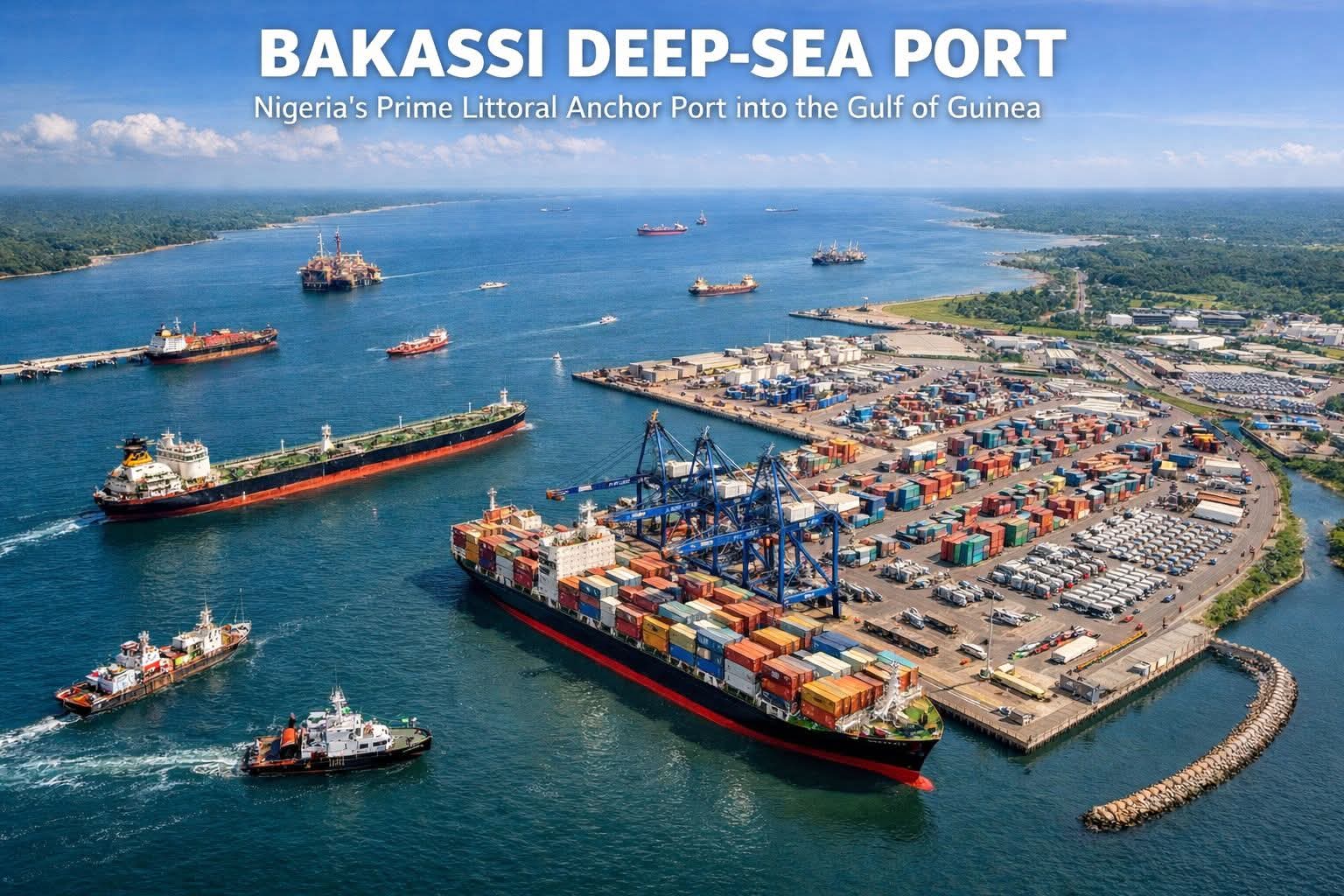
At the heart of this transformation is the proposed Bakassi Deep-Sea Port located at Kwa Island in Bakassi Local Government Area, within the Cross River Estuary and Nigeria’s direct Atlantic frontage.
The port represents a rare convergence of geographic advantage, protected maritime access, continental trade connectivity and long-term industrial scalability.
For global infrastructure investors, port operators, sovereign funds and logistics developers, Bakassi offers something increasingly scarce: a naturally advantaged deep-sea gateway with first-mover positioning into the Gulf of Guinea and Central African trade flows.
A $300 BILLION GULF OF GUINEA COASTLINE OPPORTUNITY
The Gulf of Guinea coastline economy — spanning over 26 coastal corridor states and maritime economies — is conservatively projected to generate over USD $300 billion in economic value within the next decade.
Nigeria’s maritime coastline sits at the heart of this opportunity, stretching contiguously from Calabar through Badagry, supported by continuous continental shelf rights, dense consumer markets, energy infrastructure, and expanding industrial corridors.
The Bakassi Deep-Sea Port at Kwa Island represents the holding environment and prime littoral anchor into this emerging Gulf of Guinea coastline economy. It provides the physical gateway through which trade volumes, energy services, logistics flows and industrial supply chains can be aggregated, processed and redistributed across the region.
A NATURALLY BANKABLE LOCATION
Kwa Island sits less than six nautical miles from the open Atlantic Ocean, making it Nigeria’s closest navigable maritime access point into international shipping lanes.
This proximity dramatically reduces channel dredging costs, vessel waiting time, fuel burn, insurance exposure and operational inefficiencies — variables that directly influence port profitability.
Unlike congested western ports constrained by urban density and legacy congestion, Bakassi offers greenfield scalability with minimal resettlement pressure and long-term expansion capacity for:
Multi-purpose container terminals
Bulk and break-bulk cargo
Energy logistics and offshore services
Ro-Ro vehicle terminals
Free trade and logistics parks
The surrounding estuarine waters benefit from hydrological stability reinforced by international maritime boundaries, ensuring navigational predictability and operational reliability.
MARITIME ADMINISTRATIVE HUB OF the GULF OF GUINEA BASINS.
The proximity of Kwa Island to the Cross River Basin positions the Bakassi port system as a natural maritime administrative and coordination hub for multiple Gulf of Guinea sedimentary and economic basins.
Within immediate maritime reach lie:
Douala Basin (Cameroon)
Rio Del Rey Estuary (Nigeria–Cameroon)
Niger Delta Basin (Nigeria)
Rio Muni Basin (Equatorial Guinea)
Gabon Basin (Gabon)
This geographic convergence enables Nigeria to initiate structured regional platforms including:
Joint Development Zones (JDZs)
Production Sharing and Unitization Frameworks
Cross-border Energy Monetisation Corridors
Joint Trade Processing and Logistics Zones
For investors, this unlocks scalable multi-jurisdictional growth optionality anchored from a single operational hub.
A PORT ANCHORED IN LEGAL AND SOVEREIGN CERTAINTY
Investor confidence in long-horizon infrastructure depends on legal clarity and sovereign stability. The Bakassi maritime corridor benefits from internationally recognized boundaries established under the 2002 ICJ Judgment and anchored in UNCLOS maritime frameworks.
This creates predictability in maritime access rights, shipping continuity, offshore spatial planning, security jurisdiction and future port expansion corridors — materially reducing geopolitical and regulatory risk exposure over 30–50 year asset lifecycles.
INTEGRATED Trade Corridors AND MARKET REACH.
Bakassi is uniquely positioned as a multimodal convergence hub.
The Lagos–Calabar Coastal Highway provides direct inland evacuation linking Nigeria’s largest consumer markets and industrial clusters.
The Trans-African Highway through Ikom connects Nigeria into Cameroon, Central Africa and transcontinental trade corridors.
AfDB-backed agro-industrial processing zones in Odukpani and Ikom generate immediate cargo flow through agricultural processing, light manufacturing and export aggregation.
Together, these corridors allow Bakassi to serve both Nigerian domestic demand and cross-border cargo flows under the African Continental Free Trade Area (AfCFTA) — unlocking access to over 1.3 billion consumers.
NIGERIA’S EASTERN TRADE CORRIDOR ANCHOR.
Cross River State occupies Nigeria’s last continuous inland boundary gateway through Ikom into both ECOWAS and ECCAS economic zones, supported by the AfDB and ECOWAS Trans-African Highway corridor.
This infrastructure connects:
Abidjan – Lomé – Cotonou – Lagos – Benin – Onitsha – Enugu – Abakaliki – Ikom – Cameroon – Central Africa
This establishes Cross River as Nigeria’s primary non-oil export trade corridor by land, while the Bakassi Deep-Sea Port complements this role by supporting both oil exports and high-volume non-oil maritime trade.
BLUE ECONOMY AND ENERGY UPSIDE.
Bakassi sits within a hydrocarbon-rich geological belt linking the Niger Delta to the Rio del Rey Basin. The port enables monetisation of offshore energy logistics, gas services, marine engineering, fisheries processing, cold-chain exports and coastal tourism.
These diversified revenue streams strengthen asset resilience and hedge against sector volatility.
Conservative modelling indicates that the Bakassi ecosystem could catalyse over USD $50 billion in cumulative economic value within the next decade.
CROSS RIVER STATE: INVESTOR-READY, GOVERNANCE-STABLE AND INFRASTRUCTURE-ENABLED.
Beyond geography, investors prioritise governance quality and execution reliability. The leadership of Governor Senator Prince Bassey Edet Otu reflects a deliberately cosmopolitan, investor-oriented model of corporate governance anchored on a “People First” philosophy and the “Season of Sweetness” governance framework.
Significant investment in roads, power, water, healthcare, education, skills development, security and citizen welfare has strengthened social stability and reduced operational risk for private capital.
A proposed rail logistics corridor linking the Bakassi Deep-Sea Port to the Obudu cargo terminal axis offers transformational efficiency — unlocking hinterland markets and improving cargo velocity.
ONWARD A NIGERIAN MUNICIPAL INVESTMENT CENTER.
Globally, countries deliberately concentrate financial intelligence, sector coordination and capital aggregation within designated municipal hubs. In the United States, California, New York and Texas operate as sector-driven investment intelligence centers anchoring capital markets, innovation ecosystems and logistics command platforms.
Nigeria is approaching a similar strategic inflection point.
By virtue of its economic geography, maritime proximity and infrastructure architecture, Cross River State stands unmatched as a candidate for a Nigerian Municipal Investment Center.
The state uniquely integrates a triple gateway platform — Land, Air and Sea:
SEA: Bakassi Deep-Sea Port anchoring Atlantic access and offshore energy corridors.
LAND: Trans-African Highway linking ECOWAS and ECCAS trade networks.
AIR: Margaret Ekpo International Airport supporting executive mobility and cargo connectivity.
No other Nigerian subnational geography presently combines this depth of maritime access, continental land reach, aviation connectivity, legal maritime clarity and greenfield scalability.
Institutionalising Cross River as Nigeria’s Municipal Investment Center would consolidate investment intelligence, improve project bankability and accelerate capital deployment across strategic sectors.
WHY FIRST MOVERS WIN AT BAKASSI. .
Bakassi offers first-mover advantages including strategic greenfield access, low congestion entry, scalable land banking, strong governance alignment and multi-jurisdictional trade leverage.
Early investors benefit from terminal positioning power, ecosystem leadership and durable yield stability.
THE NEXT ATLANTIC GROWTH NODE.
For decades, Nigeria’s maritime growth concentrated in the western corridor. The Bakassi Deep-Sea Port signals a strategic eastern rebalancing — expanding trade redundancy, unlocking new supply chains and strengthening national logistics resilience.
For global investors seeking Africa’s next scalable maritime growth node, Cross River State’s Bakassi corridor represents one of the continent’s most compelling long-term infrastructure opportunities.
John Gaul Lebo. LBS, LLM (Harvard Alumni)