
By: Dr. Ochim Julius Okputu
The second day of the ongoing ca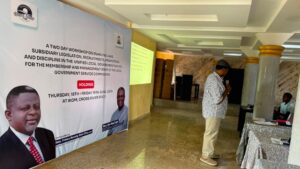 pacity-building workshop organized for members and management staff of the Cross River State Local Government Service Commission featured a thought-provoking lecture delivered by Dr. Ochim Julius Okputu, a renowned public administration expert.
Speaking to participants at the workshop led by the Chairman of the Commission, Barr. Eyo Nsa Ekpo, Dr. Okputu examined the intricate relationship between the Local Government Service Commission, the Chief Administrator of the State (Governor) and other statutory commissions and agencies within the public service framework.
In his presentation, Dr. Okputu emphasized the importance of understanding the constitutional and administrative boundaries that define interactions among government institutions. He explained that while the Governor, as the Chief Administrator of the State, exercises general oversight over government affairs, the Local Government Service Commission possesses clearly defined statutory responsibilities that must be carried out within the confines of the law.
The lecturer highlighted key areas of interaction between the Governor and the Commission, particularly in matters relating to administrative control, policy oversight, accountability, and the implementation of government programmes. He stressed that effective governance depends on mutual respect for institutional mandates and adherence to established legal frameworks.
Dr. Okputu further provided participants with insights into the structure and hierarchy of statutory commissions, outlining their scope, jurisdiction, and operational responsibilities. According to him, understanding institutional relationships is critical to avoiding conflicts of authority and ensuring seamless service delivery at all levels of government.
A major aspect of the lecture focused on personnel management within the local government system. He outlined the core functions of the Local Government Service Commission, which include recruitment, promotion, discipline, deployment, and welfare administration of local government personnel. These functions, he noted, are fundamental to maintaining professionalism, efficiency and accountability in local government administration.
The resource person also underscored the need for collaboration among government agencies and commissions, stressing that effective public service administration requires synergy rather than competition. He cautioned against actions that could be interpreted as institutional overreach, urging officials to remain guided by due process and statutory provisions.
In his recommendations, Dr. Okputu advocated regular consultations among relevant stakeholders, adherence to constitutional roles, and the adoption of diplomacy in resolving administrative disagreements. He encouraged members of the Commission to prioritize constructive engagement over confrontation while strengthening their capacity through continuous learning and professional development.
Concluding his presentation, Dr. Okputu reiterated that strong institutions are built on cooperation, respect for the rule of law, and commitment to service. He noted that when commissions, agencies, and executive authorities operate within their respective mandates while maintaining healthy working relationships, the ultimate beneficiaries are the citizens who rely on efficient and responsive governance.
The two-day workshop continues to provide a valuable platform for knowledge sharing, institutional strengthening, and the promotion of best practices in local government governance.