
By: Imoke Etorti, Ph.D.
Against the dignified backdrop of scholarly grandeur, the University of Uyo on Saturday, April
25, 2026, transformed into a crucible of intellectual reflection and institutional introspection as it hosted the 6th Distinguished Annual Registry Lecture at its majestic 1,000-seater TETFund Auditorium.
The occasion, which drew together a kaleidoscope of academicians, policymakers, traditional custodians, security chiefs, diplomats, media professionals, and administrative stalwarts, unfolded as more than a ceremonial gathering—it became a resonant symposium on the future of higher education in Nigeria.
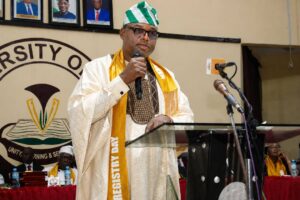
At the heart of this academic colloquium stood Amb. Dr. Gabriel O. Egbe, Ph.D, a cerebral administrator and Registrar of the University of Education and Entrepreneurship, Akamkpa, whose lecture, “Leadership for Change: The Way Forward for University and Societal Transformation,” reverberated with the force of both conviction and scholarly gravitas.
Before the first note of discourse was struck, the atmosphere was graced by the warm and eloquent welcome of the dignitaries by the Chief Host, Mrs. Blossom Ebere Okorie, the Registrar of the University of Uyo. With measure administrative grace, she extended heartfelt appreciation to all dignitaries and participants for their presence, particularly acknowledging the guest lecturer for honoring the invitation despite his demanding schedule.
She framed the lecture as a timely intellectual mirror reflecting the urgent realities of leadership and transformation in Nigeria’s university system, expressing confidence that the deliberations would yield enduring institutional value and developmental insight.
Her words set the tone for an academic voyage that would traverse critique, reflection, and reformist imagination.
Taking the podium, Dr. Egbe delivered a lecture that was as cerebral as it was compelling, weaving logic with metaphor and analysis with vision. With a voice that carried both authority and persuasion, he reimagined the university not merely as an ivory tower of credentialing, but as a pulsating engine of societal metamorphosis.
In one of the most striking moments of his discourse, he declared: “The tragedy of our universities is not the absence of vision, but the persistent failure of leadership to translate vision into transformative reality.”
With surgical precision, he dissected the challenges and encumbrances affecting Nigeria’s Tertiary educational milieu to include: chronic underfunding, political encroachment, infrastructural decay, intellectual migration, and curricular stagnation—describing them as structural afflictions that have hardened into institutional inertia.
Yet, his lecture was not a lamentation of decline; it was a clarion call to the renaissance. He urged a departure from administrative routine into the realm of transformative leadership—a leadership ethos anchored on vision, integrity, innovation, and accountability. For Dr. Egbe, leadership must not merely preside; it must provoke progress.
It must not merely manage; it must metamorphose.
Advancing a reformist blueprint, he advocated a paradigmatic shift from the archaic “grammar school” orientation of higher education to an entrepreneurial, skills-driven, and innovation-centric academic ecosystem. Such a transformation, he argued, would empower graduates not only to seek employment but to create it.
He further articulated a multidimensional reform agenda encompassing diversified funding streams, enhanced institutional autonomy, accelerated digital transformation, curriculum reinvention, improved staff welfare, and robust accountability frameworks—pillars he described as indispensable to institutional rebirth.
In a moment of philosophical candour, he illuminated the paradox of power and principle, observing that many who once critique institutional decay often find themselves constrained by the very structures they inherit upon assuming leadership roles—a reflection, he suggested, of systemic rigidity rather than personal failure alone.
The intellectual gravity of the lecture was further complemented by symbolic institutional activities, including the administration of oath of office to newly appointed administrative staff and a courtesy engagement with the university’s management—gestures emblematic of continuity, renewal, and institutional consolidation.
The event attracted an assemblage of distinguished personalities, including the special guest of honor, Hon Chief Reuben Clifford Wilson, member UniUyo’s Governing Council (represented), Vice-Chancellor, Professor Samuel Odewumi; former Vice-Chancellor, Professor Akpan Ekpo; Deputy Vice-Chancellors; the University Registrar; the University Librarian; the Bursar; Deans; Directors; and Heads of Departments.
Also in attendance were Hon. Unyime Idem, Chairman of the occasion and Member representing Ukanafun/Oruk Anam Federal Constituency; senior government officials; security chiefs; traditional rulers; and members of the press corps.
Across the auditorium, one sentiment resonated in quiet unanimity—the lecture was not merely heard; it was experienced. It was described by participants as timely, transformative, and intellectually invigorating, offering both a searing critique of present realities and a luminous roadmap for institutional renewal.
As the curtains gently fell on the event, Dr. Egbe left the audience with a resonant aphorism that lingered like a philosophical echo: “True change begins within us; we are both the agents and architects of the transformation we desire.”
Thus, the 6th Distinguished Registry Lecture etched itself into institutional memory—not merely as an academic gathering, but as a catalytic moment of reflection and resolve, rekindling the collective aspiration for a university system anchored on vision, courage, and transformational leadership.