
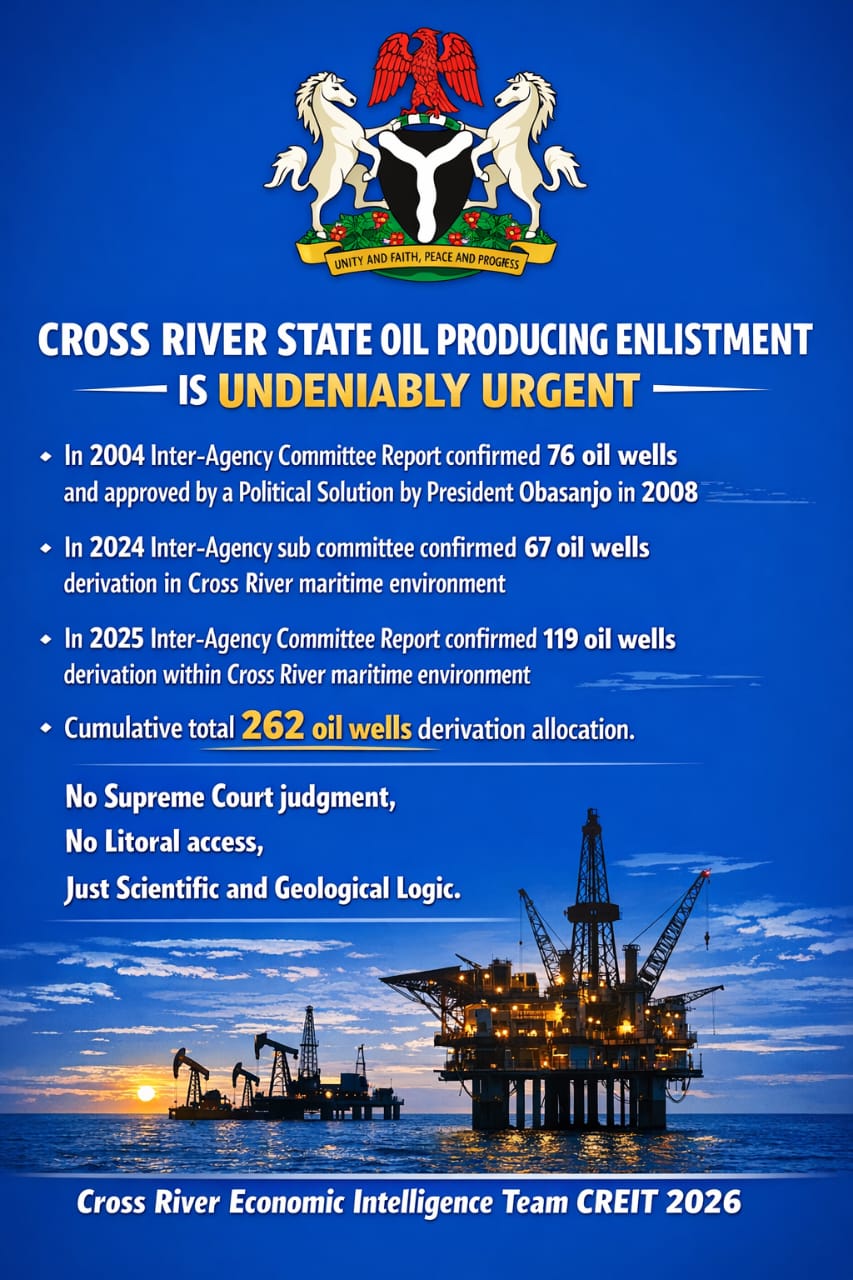
Across the world, maritime boundaries and offshore oil well attribution are determined through scientific surveys, hydrographic analysis and geological logic.
They are not determined by administrative maps or provisional policy instruments. The long-standing debate over the oil-producing status of Cross River State therefore raises an important national question: should administrative cartography override geography, hydrology and petroleum geology?
At the centre of this debate lies the Cross River Estuary, one of the largest estuarine systems along the eastern Gulf of Guinea.
Stretching from Calabar through the Calabar Channel and opening into the Atlantic Ocean, the estuary functions as a natural maritime corridor linking the Cross River Basin to the Gulf of Guinea. The system is characterized by tidal mangrove wetlands, deep estuarine channels and direct ocean connectivity. Hydrologically, the estuary experiences continuous tidal exchange with the Atlantic while the Cross River discharges enormous volumes of freshwater and sediments into the coastal marine environment.
These characteristics place the basin firmly within the Atlantic coastal ecosystem rather than an isolated inland drainage system.
Beneath the surface lies an equally compelling geological reality.
Most offshore oil fields in southern Nigeria belong to the Niger Delta petroleum system, one of the most prolific hydrocarbon provinces in the world. Geological studies show that this petroleum system extends eastward into the Calabar Flank, the sedimentary basin adjoining Cross River State.
The Niger Delta petroleum system consists of the Akata Formation, which provides hydrocarbon source rocks; the Agbada Formation, which forms the principal reservoir rocks; and the Benin Formation, which provides the overburden sediments. Seismic and geological analysis suggests that hydrocarbon structures associated with these formations extend toward the eastern offshore corridor bordering the Cameroon Basin.
In petroleum geology, reservoirs frequently extend across administrative or political boundaries.
For this reason, modern petroleum law provides for unitisation, allowing reservoirs that cross boundaries to be jointly developed while production is proportionally shared.
Assigning wells rigidly to a single jurisdiction without examining reservoir continuity therefore contradicts the basic logic of petroleum science.
Much of the controversy surrounding Cross River’s oil-producing status stems from the 2008 oil well attribution map, produced during the implementation of Nigeria’s oil dichotomy policy. The map was originally designed as an administrative tool to guide derivation calculations, assisting federal agencies in allocating offshore oil wells for revenue purposes. Over time, however, the map began to be treated as if it were a definitive maritime boundary instrument between Cross River and Akwa Ibom States.
This interpretation presents a serious conceptual problem. Administrative resource maps are fundamentally different from maritime boundary demarcation instruments.
Genuine boundary maps require hydrographic surveys, geodetic coordinate systems, legally defined baselines and formal boundary demarcation procedures. The 2008 map satisfied none of these requirements.
Two key maritime boundaries also remain scientifically unresolved.
The first concerns the offshore tri-junction between Nigeria, Cameroon and Equatorial Guinea in the Gulf of Guinea.
The second relates to the internal maritime boundary between Cross River State and Akwa Ibom State. Until these boundaries are properly surveyed, defined through geodetic coordinates and formally demarcated, any permanent oil well attribution based solely on a provisional administrative map remains inherently questionable.
The implications extend beyond derivation revenue. Within the Cross River Estuary lies an estimated 780 hectares of maritime waters whose governance remains uncertain due to unresolved jurisdictional interpretation.
In a region where the Gulf of Guinea continues to face maritime security challenges, leaving such a significant estuarine corridor without clear jurisdiction raises legitimate national security concerns. Ungoverned maritime spaces often attract illegal fishing, smuggling, unregulated navigation and other forms of transnational maritime crime. Clarifying the governance of the Cross River estuarine corridor therefore serves not only fiscal fairness but also Nigeria’s maritime security interests.
The legal dimension of the dispute is often linked to the Supreme Court judgments delivered in 2005 and 2012, which addressed constitutional questions concerning derivation and littoral status. Yet it is important to understand the limits of those rulings.
The Court interpreted legal and constitutional questions relating to derivation entitlement; it did not conduct hydrographic surveys, geological mapping or petroleum reservoir analysis. In effect, the law replaced scientific logic in determining the outcome.
Crucially, the judgments did not relocate the physical coordinates of oil wells or petroleum reservoirs from Cross River to Akwa Ibom State. Oil wells exist at specific geodetic coordinates established by petroleum regulators and defined through exploration and drilling activities. Courts interpret legal entitlement, but they do not move geological structures beneath the seabed.
In truth, the main source of injustice to Cross River State’s oil-producing status does not lie in the International Court of Justice judgment over the Bakassi Peninsula in 2002, nor in the Supreme Court decisions in Attorney General Cross River v. Attorney General Akwa Ibom (2005) or Attorney General Cross River v. Attorney General of the Federation (2015).
The greatest single source of injustice arises from the unilateral implementation of the 200-metre isobath principle under the Offshore/Onshore Dichotomy Abrogation framework, which effectively favoured Akwa Ibom State. By drawing maritime baselines from Tom Shot Island into the Cross River Estuary, the implementation crossed the edge of Nigeria’s continental shelf geological formations and extended Akwa Ibom’s projection into offshore areas that historically formed part of the Cross River maritime corridor.
The result was that Akwa Ibom gained access to several offshore oil wells for derivation allocation, while Cross River’s offshore boundary and littoral status were effectively eliminated.
Yet geology may ultimately prove more enduring than administrative decisions. Cross River State is scientifically fortunate to lie along a high-quality hydrocarbon reservoir belt associated with the Niger Delta petroleum system and connected to the Calabar Geological Flank. Geological evidence indicates the presence of extensive reservoir potential within the region, including onshore and nearshore petroleum structures located within the limited offshore corridor that remains available to Cross River beyond the 200-metre isobath zone.
These formations suggest that the state continues to sit atop a viable hydrocarbon province with significant exploration potential.
In the final analysis, the issue presents the President of Nigeria with a major decision science and resource governance challenge.
The federal government must decide whether to initiate a scientific reassessment capable of recovering and retaining the additional coordinates of approximately 245 oil wells, the 780 hectares of maritime waters within the Cross River Estuary omitted by the 2008 oil dichotomy implementation map, and the geological continuity of 49 transboundary reservoirs straddling wells including those connected to OML 114 in the Abana Field.
The alternative is to continue relying on the present framework that effectively sustains Akwa Ibom State’s permanent claim to 76 oil wells, a claim largely supported by interpretations of the 2005 and 2012 Supreme Court judgments—judgments which themselves never suspended the application of scientific and geological processes in determining oil well attribution.
The broader strategic question is unavoidable.
How can Africa’s largest oil-producing nation implement an oil dichotomy attribution map in 2008 without first demarcating the full extent and limits of its offshore boundary with Cameroon and Equatorial Guinea? Such a situation leaves critical geospatial questions unresolved in one of the most sensitive petroleum provinces in the Gulf of Guinea.
Resolving the Cross River issue therefore requires a comprehensive technical reassessment involving hydrographic mapping of the Cross River–Akwa Ibom offshore corridor, determination of the Nigeria–Cameroon–Equatorial Guinea maritime tri-junction, formal demarcation of internal maritime boundaries and independent verification of oil well coordinates and reservoir structures.
Only such a scientific review can ensure that Nigeria’s petroleum governance system reflects geographical reality, geological logic and constitutional fairness.
Ultimately, the Cross River case is not merely a dispute between neighbouring states.
It is a test of whether Nigeria’s maritime resource governance will be guided by science, evidence and geospatial accuracy. Maritime boundaries and petroleum reservoirs do not obey provisional administrative maps.
They follow the deeper logic of geography, hydrology and geology. Recognizing this principle is essential if Nigeria is to maintain a credible, scientifically grounded and nationally secure petroleum governance system.
John Gaul Lebo, LLM, LBS (Harvard Alumni)
CREIT – Cross River Economic Intelligence
February@ 2026