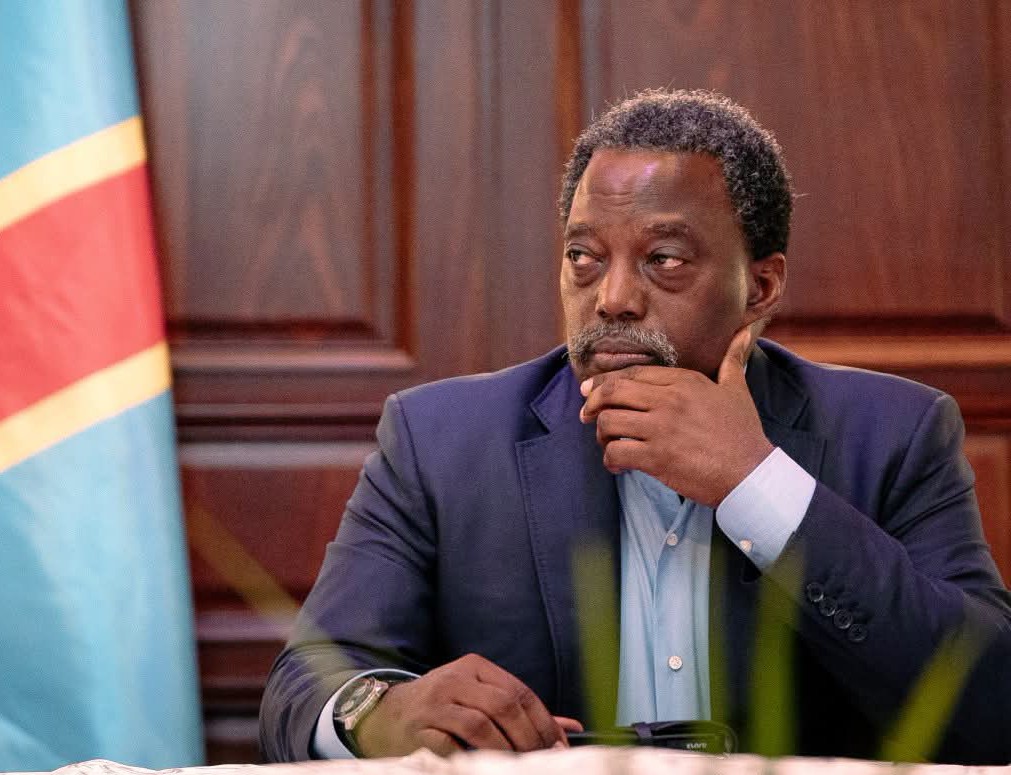
Former President of the Democratic Republic of Congo, Joseph Kabila, has formally joined forces with the M23 rebel movement to head a new political-military coalition, marking his most direct involvement yet in the insurgency ravaging eastern Congo.
The new alliance, named the Front for the Refoundation of the Nation (FRN) – Front pour la Refondation de la Nation – was unveiled on Monday, October 12, 2026, at a press conference at Kabila’s residence in Goma, the capital of North Kivu province.
Goma has been under the control of the M23 since January 2025 after the Rwanda-backed group seized large swaths of territory in mineral-rich eastern DRC in a lightning offensive.
According to the coalition’s adviser, Claude Ibalanky, the FRN is a “politico-military” outfit that will “pool their strengths, resources and means” with the aim of “putting an end to tyranny by any means, including force.”
Under the new structure, Kabila, 55, who ruled the DRC from 2001 to 2019, will head the movement. Senior figures of the rebellion will serve as his deputies. Corneille Nangaa, former head of the electoral commission and former leader of the Congo River Alliance (AFC), Bertrand Bisimwa, senior political leader of M23 and Sultani Makenga, military commander of M23 and Freddy Kaniki.
The FRN replaces the Congo River Alliance (AFC), which until now served as the political wing of the M23. It also brings together several other allied armed groups.
The announcement comes three days after Kabila delivered a national address on Friday, October 10, where he accused President Felix Tshisekedi’s government of corruption, economic mismanagement, insecurity in the east, and repression of opponents. He also criticized Kinshasa’s recent minerals deal with the United States.
Congolese authorities have for months accused Kabila of being behind the AFC/M23 rebellion, an allegation he had previously denied.
On September 30, 2025, the DRC’s High Military Court sentenced Kabila to death in absentia after finding him guilty of treason, war crimes and crimes against humanity over alleged support for the M23 insurgency. Kabila dismissed the trial as politically motivated.
The Tshisekedi government is yet to officially react to the formation of the FRN, but analysts say it represents a major escalation and a serious complication for the ongoing peace process, which has had limited success.
M23 is one of about 100 armed groups fighting for control in eastern Congo, a conflict that has created one of the world’s largest humanitarian crises. The DRC, the United States and UN experts accuse Rwanda of backing M23 and exercising command over it, a charge Rwanda denies.
Kabila, who came to power at age 29 after the assassination of his father Laurent Kabila in 2001, and was elected in 2006 in the country’s first democratic polls since independence, had kept a low public profile since stepping down after the 2018 election that brought Tshisekedi to power.
His open alliance with M23 comes as President Tshisekedi, 63, approaches the end of his second and final five-year term in 2028, amid growing debate over a possible constitutional amendment to extend presidential term limits.