
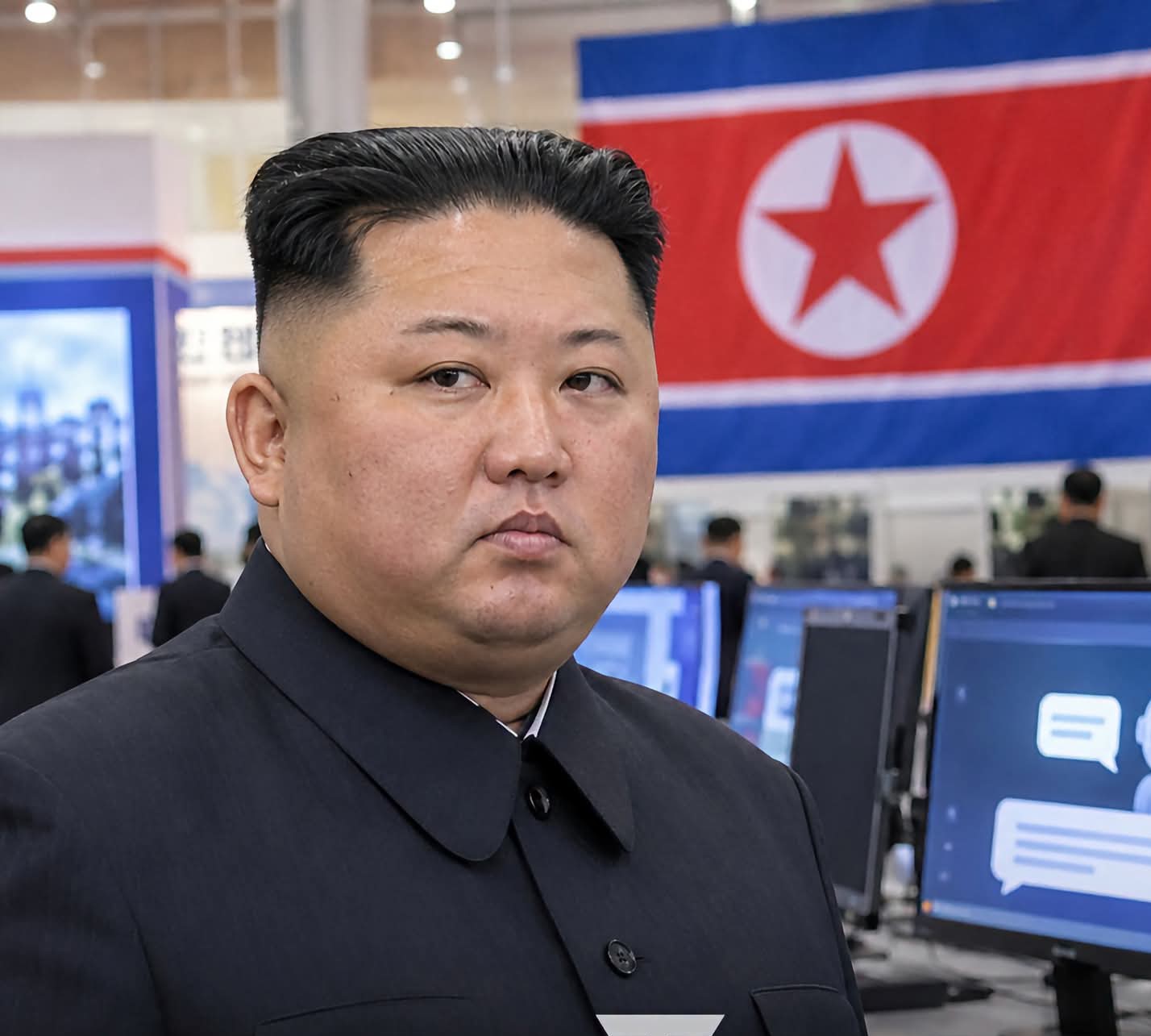
North Korea has reportedly developed and unveiled its first publicly showcased artificial intelligence (AI) chatbot, named “Fountain of Wisdom,” in a move showing the country’s growing interest in emerging technologies. However, the new platform comes with strict restrictions, warning users against asking questions relating to politics and social issues.
The chatbot, officially identified as “AI Service System 1.0 Fountain of Wisdom,” was showcased at the National Exhibition of Information Technology Successes held in Pyongyang, North Korea, from October 19 to 30, 2026. Its appearance was subsequently featured in a television report broadcast by North Korea’s Ryongnamsan TV on November 17.
According to a report by 38North, a United States-based research organisation that monitors developments in North Korea, the platform was developed through a collaboration between the Artificial Intelligence Technology Research Institute at Kim Il Sung University and Phurunhanul Trading Company, a Pyongyang-based software development and technology company.
The chatbot is designed to respond to questions relating primarily to science and technology. It reportedly supports both Korean and English languages and offers additional functions, including information summarisation and translation services.
Footage from the exhibition showed the system responding to a question about generating electricity using natural energy sources, providing a demonstration of its potential applications in scientific research, education and technological development.
Despite its technological capabilities, however, the platform operates under strict content restrictions.
An explicit warning displayed at the bottom of the chatbot’s interface instructs users to submit only questions related to science and technology. It specifically prohibits questions containing socio-political content or what it describes as uncultured material.
The warning further states that users will bear full responsibility for any consequences arising from the malicious use of the system.
Interestingly, analysis of the television footage by 38 North suggests that the chatbot may have an additional screening mechanism designed to examine questions before they are submitted to the underlying artificial intelligence engine.
During the demonstration, the system was seen displaying an analysing notification and classifying an incoming question as a factual knowledge inquiry. This suggests that a filtering mechanism may be in place to identify and potentially block questions involving prohibited subjects.
Although North Korea has presented the platform as a domestic technological achievement, questions remain about the underlying artificial intelligence technology powering it.
According to 38 North’s assessment, the chatbot’s interface bears similarities to those used by internationally recognised AI platforms, including ChatGPT.
However, the research organisation suggests that the actual AI model powering the system may have been adapted from existing open-weight models developed outside North Korea rather than being built entirely from scratch by local researchers.
Among the possible technologies mentioned are Google’s Gemma and Alibaba’s Qwen, both of which provide AI models that developers can adapt for different applications.
Nevertheless, North Korean authorities have not publicly disclosed the specific model, hardware infrastructure or technical architecture supporting the chatbot.
The country’s limited access to large-scale data centres and advanced computing infrastructure could also present challenges to deploying more sophisticated AI systems on a nationwide scale.
The unveiling of Fountain of Wisdom raises interesting questions about the relationship between technological advancement, information access and government control in one of the world’s most tightly regulated societies.
North Korea maintains extensive restrictions on access to information, international media and the internet. Consequently, the introduction of an AI chatbot that explicitly prohibits political and social questions reflects the controlled environment within which emerging digital technologies are being introduced.
Unlike many internationally available AI platforms that support discussions across a wide range of subjects, North Korea’s new chatbot appears deliberately positioned as a specialised information resource for scientific and technological inquiries.
The restrictions also raise questions about the extent to which artificial intelligence can be developed and deployed as an educational and research tool while limiting access to information on sensitive subjects.
Interestingly, the technology itself is not entirely new to North Korean digital operations. According to 38 North, North Korean hackers, cybercriminals and overseas IT workers have previously been identified as users of AI chatbots to support aspects of their activities.
What makes the latest development particularly significant is that it represents an AI chatbot being publicly showcased through North Korean state media as a domestic technological product.
The unveiling of Fountain of Wisdom signals North Korea’s intention to participate in the rapidly expanding global artificial intelligence industry, despite its technological limitations and international isolation.
While the chatbot’s actual capabilities, accessibility and potential nationwide deployment remain unclear, its introduction demonstrates an interest in applying AI to scientific research, information processing, translation and other knowledge-based activities.
For now, however, North Korean users who wish to interact with their country’s new AI assistant must observe one important rule: questions about science and technology are welcome, but political and social questions are off limits.
The development offers another example of how artificial intelligence is becoming an increasingly important part of national technological strategies around the world, even as governments adopt different approaches to regulating what their citizens can ask, access and learn through the technology.